
Turn a complex idea into a product built to move beyond launch
A strong product needs more than a list of features and a development team.
SVAAPTA works with funded founders and innovation teams to turn meaningful digital-product ideas into viable, dependable software.
Turn a complex idea into a product built to move beyond launch
A strong product needs more than a list of features and a development team.
SVAAPTA works with funded founders and innovation teams to turn meaningful digital-product ideas into viable, dependable software.
We work best with founders who are ready to make real product decisions
Early-stage does not have to mean unstructured.
The strongest founder engagements begin with a meaningful problem, committed product ownership and realistic resources to turn the idea into working software.
You do not need every requirement documented before speaking with us. Discovery exists precisely because many product decisions still need to be made.
But there should be enough commercial intent and commitment to build responsibly.
You understand the problem you want the product to solve.
You understand the problem you want the product to solve.
Custom technology is important to the business rather than incidental to it.
Custom technology is important to the business rather than incidental to it.
A founder or product owner can make decisions and remain involved.
A founder or product owner can make decisions and remain involved.
Funding is available or committed for meaningful product development.
Funding is available or committed for meaningful product development.
You are willing to prioritise rather than attempt to build every idea in the first release.
You are willing to prioritise rather than attempt to build every idea in the first release.
You value maintainability and future evolution, not only getting something online quickly.
You value maintainability and future evolution, not only getting something online quickly.
You are looking for a technology relationship that can continue beyond the initial launch.
You are looking for a technology relationship that can continue beyond the initial launch.
We do not expect founders to arrive with all the answers. We do expect a serious commitment to finding the right ones.
The first challenge is deciding what the product actually needs to become
A founder may understand the market problem deeply without yet knowing the best product workflow, technical architecture or first-release scope.
That is normal.
Our role is to help turn that knowledge into decisions engineering can work with.
Before significant development begins, we can help clarify users, journeys, priorities, assumptions, integrations, architecture and the smallest meaningful release that can support the business case.
Product and business context
Product and business context
Clarify the target users, problem, business model, assumptions and intended outcome.
User journeys
User journeys
Map how different users interact with the product and identify the workflows that matter most.
Feature prioritisation
Feature prioritisation
Separate first-release requirements from valuable ideas that can follow later.
Technical feasibility
Technical feasibility
Assess complex integrations, external platforms, data requirements and other technical dependencies before committing to implementation.
Solution architecture
Solution architecture
Define an appropriate foundation for the first production product without introducing unnecessary complexity.
Delivery roadmap
Delivery roadmap
Translate priorities into a structured release approach with assumptions, dependencies and indicative delivery effort.
An MVP should test the business proposition — not simply be a smaller version of every planned feature
Building less can be valuable, but only when the right things are left out.
A responsible first-release scope should preserve the product journey that makes the proposition meaningful while postponing features that do not yet need to exist.
We help founders make those trade-offs explicitly.
- What must work for the product proposition to be credible
- Which users need to be served first
- Which assumptions need to be tested
- Which integrations are genuinely required
- Which manual processes are acceptable initially
- Which technical decisions would be expensive to reverse later
- What can responsibly wait until later releases
The goal is not the cheapest possible first version. It is the smallest responsible product capable of moving the venture forward.
Bring product thinking and engineering together through one delivery relationship.
Product and solution design
Product and solution design
Translate business concepts into workflows, requirements, product priorities and technical decisions.
UX and interface design
UX and interface design
Design user journeys and interfaces around the tasks people actually need to complete.
Web and SaaS product development
Web and SaaS product development
Build browser-based platforms, SaaS products, operational applications and portals around custom requirements.
Mobile applications
Mobile applications
Develop mobile experiences where the product proposition requires native or cross-platform access.
APIs and integrations
APIs and integrations
Connect payments, communication services, third-party platforms, external data and business systems.
Architecture and cloud deployment
Architecture and cloud deployment
Establish an appropriate technical foundation and deployment environment for the product.
Quality assurance
Quality assurance
Test workflows, integrations and releases systematically before software reaches users.
Launch preparation
Launch preparation
Support production readiness, deployment, operational checks and the transition into the first live product phase.
Launching the product is a milestone, not the end of product development
The first production release creates something valuable that planning alone cannot provide: real usage.
Customers behave differently from assumptions. Priorities change. Some features prove important and others become unnecessary. New operational requirements emerge.
The product should be able to respond.
We consider maintainability, data, integrations, deployment and likely evolution when making early technical decisions, while avoiding unnecessary architecture for scale that does not yet exist.
After launch, SVAAPTA can continue supporting the roadmap as the product moves from validation towards commercial growth.
Post-launch engineering
Continue with feedback-driven enhancements, optimisation, integrations, support and product evolution.
Experience turning specialised ideas into functioning digital platforms
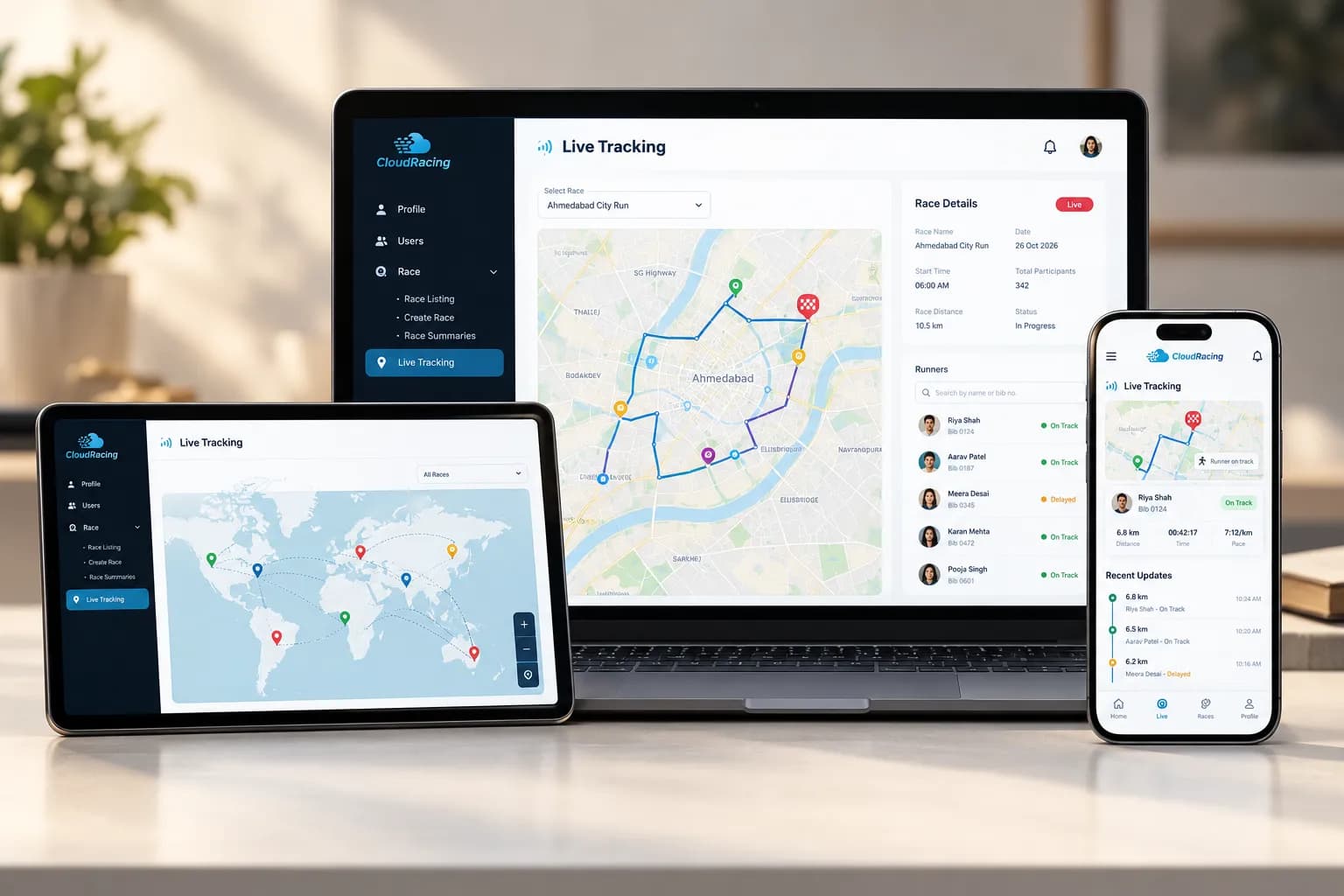
CloudRacing
Translating a specialised racing concept into a digital product.
CloudRacing demonstrates SVAAPTA’s ability to work with a founder-led concept involving specialised domain requirements and evolving product decisions.
The engagement required more than implementing predetermined screens.
It involved understanding domain-specific workflows, translating those concepts into product behaviour and supporting the development of a functioning platform around the founder’s vision.
UK-facing engagement backed by established product engineering capability in India
SVAAPTA combines UK-facing commercial engagement and solution leadership with the multidisciplinary engineering capability of SVAAPTA India.
For founders, this creates access to product, architecture, design, software engineering, QA, integration and support capabilities without needing to assemble every discipline independently.
Engagements are structured around clear responsibilities, regular communication, working-hour overlap, delivery visibility and defined ownership.
A serious product idea deserves a responsible route to market
If you have a meaningful problem to solve, committed product ownership and the resources to build a dependable first product, we can help turn the idea into something customers can actually use — and a platform the business can continue developing.