
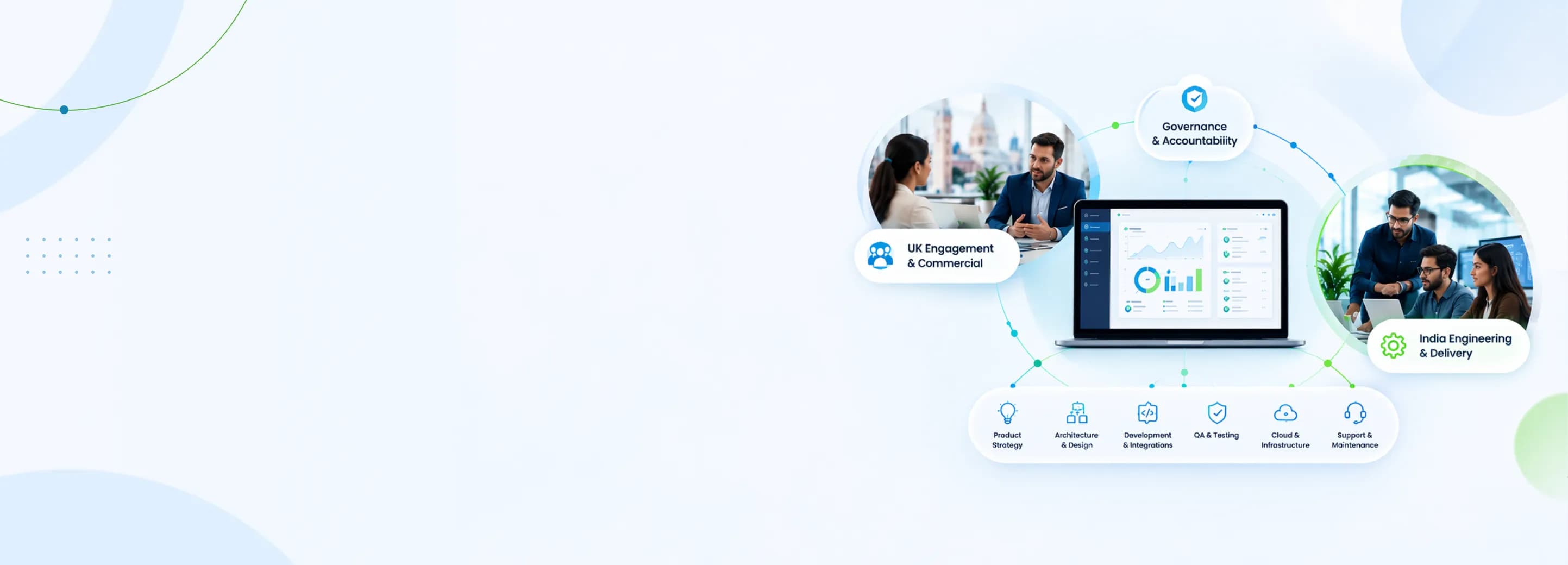
UK-facing accountability. India-backed engineering depth.
SVAAPTA combines UK-facing commercial engagement and solution leadership with the multidisciplinary software engineering and delivery capability of SVAAPTA India.
Clients have a clear commercial relationship and defined engagement ownership.
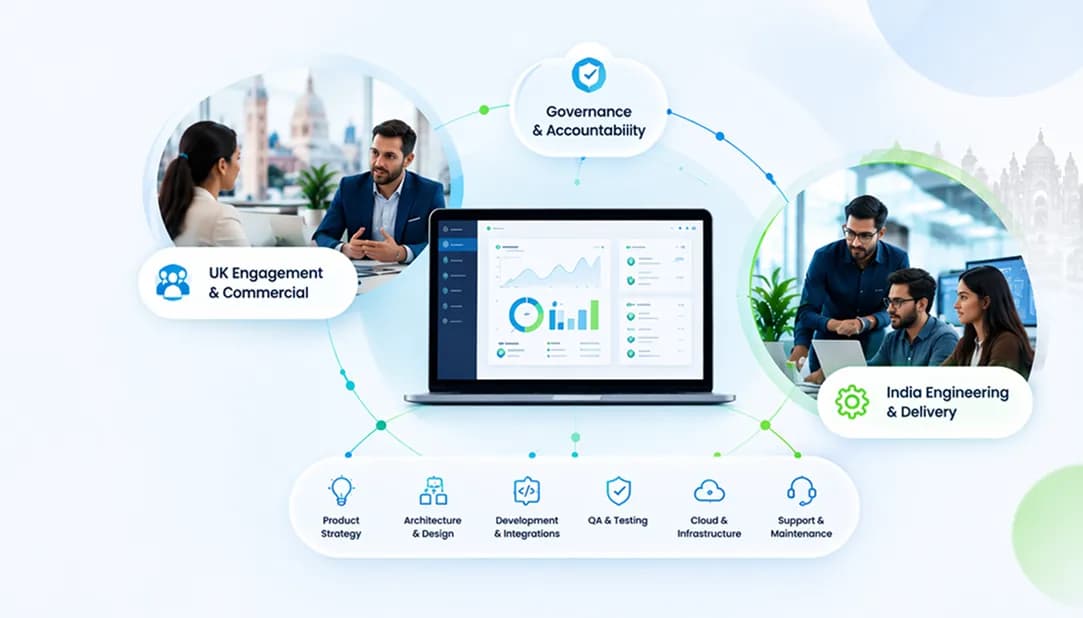
UK-facing accountability. India-backed engineering depth.
SVAAPTA combines UK-facing commercial engagement and solution leadership with the multidisciplinary software engineering and delivery capability of SVAAPTA India.
Clients have a clear commercial relationship and defined engagement ownership.
Complex technology rarely depends on one role or one location
A product may require architecture, frontend and backend engineering, QA, integrations, cloud capability, design, support and domain understanding at different stages.
Recruiting every capability internally can be difficult and unnecessary.
UK-facing engagement
UK-facing engagement
UK-facing engagement provides commercial context and clear client accountability.
Depending on the engagement, this can include
- Initial commercial discussions
- Discovery and requirement conversations
- Solution direction
- Engagement structure
- Commercial governance
- Client relationship management
- Escalation and decision support
India-based engineering capability
India-based engineering capability
SVAAPTA India provides the engineering depth and multidisciplinary delivery capability required to execute the work.
Capability may include
- Product and business analysis
- Solution architecture
- UX and UI
- Frontend development
- Backend development
- Mobile development
- APIs and integrations
- Cloud and infrastructure engineering
- Quality assurance
- Release support
- Application maintenance and support
At the same time, simply handing requirements to a remote development team can create its own problems: unclear ownership, communication gaps, fragmented decision-making and too much coordination falling back on the client.
SVAAPTA’s model is intended to sit between those extremes.
The objective is not to separate consulting from delivery. It is to connect them.
Know who owns what before the work begins
Access to a larger engineering team is useful only if the client does not become responsible for coordinating everyone.
Commercial and contracting model
Commercial and contracting model
Project-specific scope, fees, milestones, responsibilities and assumptions are documented through the applicable proposal, statement of work or work order.
One client relationship
One client relationship
SVAAPTA structures engagements around defined ownership.
Depending on the work, a client may interact primarily with a designated engagement, product or technical lead while the wider delivery team operates behind that relationship.
Shared delivery responsibility
Shared delivery responsibility
The two sides should operate as one engagement rather than independent organisations passing work between each other.
Commercial priorities, product decisions and engineering execution remain connected through agreed ownership, reporting and governance.
Delivery governance and accountability
Delivery governance and accountability
The level of governance should match the size, risk and complexity of the engagement.
The aim is to create enough structure for decisions and accountability to remain visible without adding process that does not improve the outcome.
Accountability that stays visible throughout the engagement
Ownership is agreed before the work begins, so clients know who is responsible for each decision, deliverable and escalation as the engagement progresses.
- Defined accountability — Responsibilities and expected outcomes are agreed rather than assumed.
- Appropriate specialists — Different capabilities can be introduced according to the product or technical requirement.
- Coordinated delivery — Engineering, QA, integrations and support should work within the same delivery context.
- Clear escalation — Commercial and delivery escalation routes are established at the start of the relationship.
One engagement, one line of accountability, from first conversation to delivery.
Distributed delivery works when communication is intentional
Location alone does not determine whether a technology engagement communicates well.


Working-hour overlap
Working-hour overlap
For UK engagements, working arrangements are agreed around the needs of the project and the practical overlap between UK and India working hours.
- Scheduled working-hour overlap
- Regular delivery or product meetings

Team coordination
Team coordination
Clear responsibilities, regular interaction, documented decisions and predictable communication routines matter more than location.
- Shared project-management tools
- Written decisions and action tracking
- Shared issue and risk tracking

Quality and engineering practice
Quality and engineering practice
Quality is not a final testing activity performed after development has finished.
Depending on the engagement, quality practices may include requirements clarification, architecture review, code review, structured testing, release validation and documented acceptance criteria.

Continuity and knowledge
Continuity and knowledge
Long-running technology relationships inevitably experience change. People move between assignments. Products evolve. Priorities shift.
A dependable delivery model should create organisational knowledge rather than dependency on an individual developer.
- Shared repositories
- Code review
- Documentation appropriate to the engagement
- Structured handover when responsibilities change
The client should know what is happening, what requires a decision and who owns the next action.
Confidentiality, access and data handling should be defined as part of the engagement
Software delivery frequently requires access to source code, business information, system credentials, test data and sometimes personal data.
The controls required vary according to the project and client environment.

Security and confidentiality
Security and confidentiality
SVAAPTA’s contractual and delivery framework can address confidentiality, access responsibilities, data processing, acceptable use and security requirements appropriate to the engagement.
- Confidentiality obligations
- Repository and system access
- Client credentials
- Incident escalation

Data handling and processing
Data handling and processing
Where SVAAPTA India processes personal data in support of a UK client engagement, the relevant data-processing arrangements should form part of the contractual structure.
- Development and test data
- Personal-data processing
- Data-transfer requirements
- Access removal

Intellectual property ownership
Intellectual property ownership
For bespoke work intended to belong to the client, transfer of the relevant deliverables can take place in accordance with the agreed contract and payment terms, while pre-existing tools, reusable capability and third-party rights remain appropriately protected.

Clear contractual terms
Clear contractual terms
The exact position should always be confirmed in the applicable agreement and work order.
- Client-specific deliverables
- Pre-existing SVAAPTA materials
- Third-party software and licences
- Open-source software
IP should be a contractual decision, not an assumption made after development is complete.
The relationship adapts to the maturity of the client and product

Scaleups and product companies
Scaleups and product companies
We typically work alongside internal product and technology leadership, adding engineering capacity, specialist capability and ownership of defined workstreams.

Established businesses
Established businesses
We may work with business, operations and technology stakeholders to modernise applications, integrate systems or take responsibility for ongoing application engineering.

Funded founders
Funded founders
The engagement may begin with product discovery and solution definition before moving into multidisciplinary product delivery.

Agencies and technology partners
Agencies and technology partners
SVAAPTA can support defined delivery responsibilities behind the partner relationship, subject to appropriate commercial, confidentiality and client-ownership arrangements.
Combine local commercial context with established engineering depth
If you need a technology partner that can understand the business context, take accountable ownership and access multidisciplinary engineering capability without requiring you to build every role internally, we should discuss the engagement you are considering.